The standard Salesforce implementation model, a team of developers building against a set of requirements over weeks or months, is already being outpaced by what AI can do. Most companies running Salesforce have not adjusted to this yet. The ones that figure it out early will operate with a structural advantage. The ones that do not will pay for it in ways they will not see coming until something breaks.
I am not speculating. I have been on both sides of this shift.
What I learned integrating AI into Salesforce at Yahoo
At Yahoo, I led the Salesforce side of integrating Sierra AI into our call center operations. This was not a proof of concept or an innovation lab exercise. It was production. Sierra's AI agents handled live customer interactions, and the Salesforce environment had to support that securely, at scale, and without exposing customer data outside the boundaries our team controlled.
That work required a kind of architecture most Salesforce teams never have to think about: securing the handoff between AI-generated actions and Salesforce's data layer, designing access controls that account for non-human actors, and mapping every integration dependency so that a credential rotation or a certificate expiration would not silently break an agent mid-conversation.
The experience gave me a sharp understanding of what it takes to architect AI into a Salesforce environment, not just functionally, but with the governance and security posture that enterprise operations require.
Now I am building with AI on the other side
Today I am building OrgGuard, a native Salesforce managed package where AI generates the code and I do the architecture, the security design, and the review. The velocity difference is real. What used to take a team weeks ships in days. Features that would have required multiple developers and a sprint cycle get built, tested, and hardened in a fraction of the time.
That is not unique to me. This is where Salesforce delivery is heading for everyone.
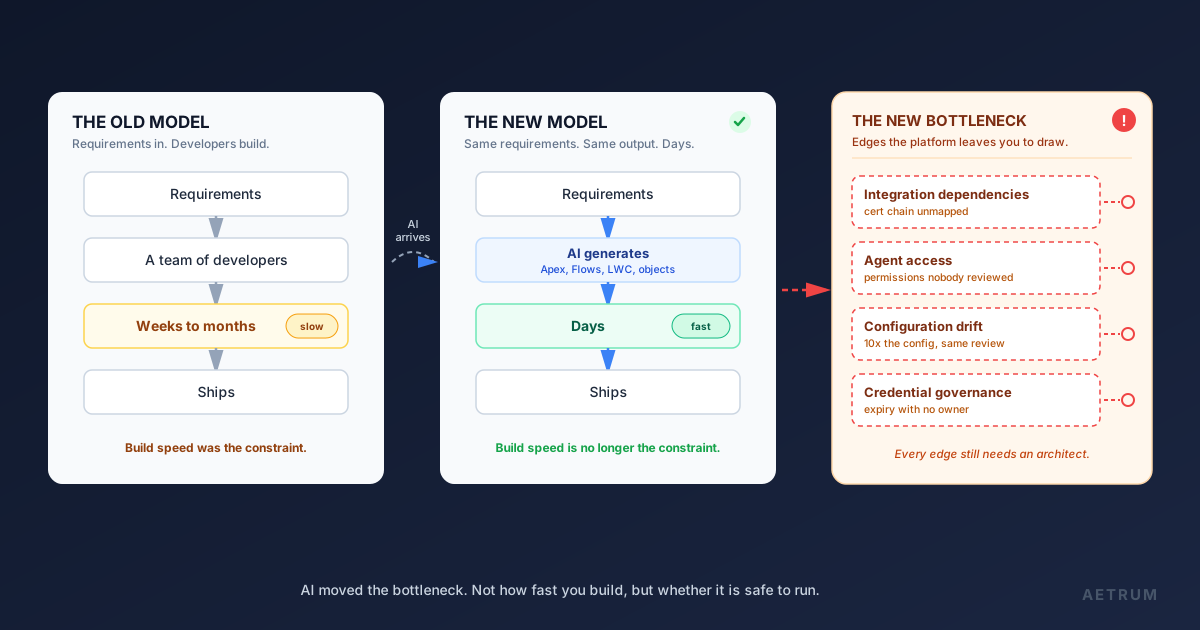
AI can generate Apex classes, build Flows, produce LWC components, and configure objects faster than most development teams can spec them. The raw speed of code generation is no longer the constraint.
The new bottleneck is architectural judgment
When AI generates code at speed, the bottleneck shifts. It is no longer about how fast things get built. It is about whether the right thing got built, and whether it is safe to run.
Here is what I mean, specifically.
Integration dependencies go unmapped. AI generates a callout class that references a Named Credential. That Named Credential depends on an External Credential, which depends on a certificate. Who owns that certificate? When does it expire? What happens to the five integrations downstream when someone rotates it? AI does not track those chains. Most teams do not either, until something stops working at 2 AM.
Access controls do not account for agents. An AI-built agent gets deployed with a permission set that grants access it should not have. Nobody reviewed what the agent can reach, because the tooling was not designed for non-human actors. This is the kind of gap a security audit catches after the fact, if it catches it at all.
Configuration drift accelerates. When a single developer can push ten times more configuration in a week, the surface area for unintended consequences grows proportionally. Flows interact with triggers that interact with validation rules that interact with sharing rules. AI does not hold the full dependency graph in its head. Someone has to.
Credential governance gets skipped. In the rush to ship, certificate chains, OAuth token scopes, and authentication provider configurations get set up to work, not to be maintainable. Three months later a credential expires, and nobody knows which integrations it supports or which team owns it.
These are not hypothetical risks. They are the operational reality of every Salesforce org that has moved fast and has not invested in governance.
Implementation teams are getting leaner. That is already happening.
This is not a prediction. Companies are already running with smaller Salesforce teams. AI-assisted development means fewer developers can produce more output. That is a real efficiency gain.
But the question is not whether your team shrinks. It is whether the people left have the architectural judgment to keep your org from breaking under the weight of what AI builds.
A developer using AI to generate Apex and Flows is productive. A developer using AI to generate Apex and Flows without an architect reviewing integration dependencies, access design, and credential governance is a liability.
The gap I fill
This is the work I do through Aetrum LLC, my consulting practice.
Service Cloud architecture. Ten years of Service Cloud expertise across case management, contact center operations, and customer support workflows. This is where I started, and it is where I still do my deepest work.
Integration governance. Mapping the full chain from Named Credentials to External Credentials to certificates to downstream callouts, so teams know exactly what depends on what before something breaks.
Security and access design. Identity management, SSO, authentication and authorization architecture, permission design, and event monitoring. This includes designing access controls for AI agents and non-human actors, not just users.
Credential dependency mapping. The work most teams defer until an outage forces them to do it. I do it proactively, so rotations and expirations are planned events rather than emergencies.
Large-scale data migration and consolidation. Millions of records across the AOL and Yahoo merger, across multiple Salesforce orgs, with full data integrity.
Fifteen years in the Salesforce ecosystem across customer support operations, enterprise integrations, subscriptions, payment processing, and regulated environments.
How I work
No full-time commitment. No six-month SOW. Architecture and governance on a contract basis, so you can move fast without accumulating the technical debt that slows you down later.
If your team is running leaner and you do not have an architect reviewing what is being built, that is the gap I fill. If your org is scaling AI-driven development and nobody owns the integration dependency map, the credential chain, or the access model, we should talk.
If this is where your team is right now
If any of this resonates with where your team is right now, reach out directly.
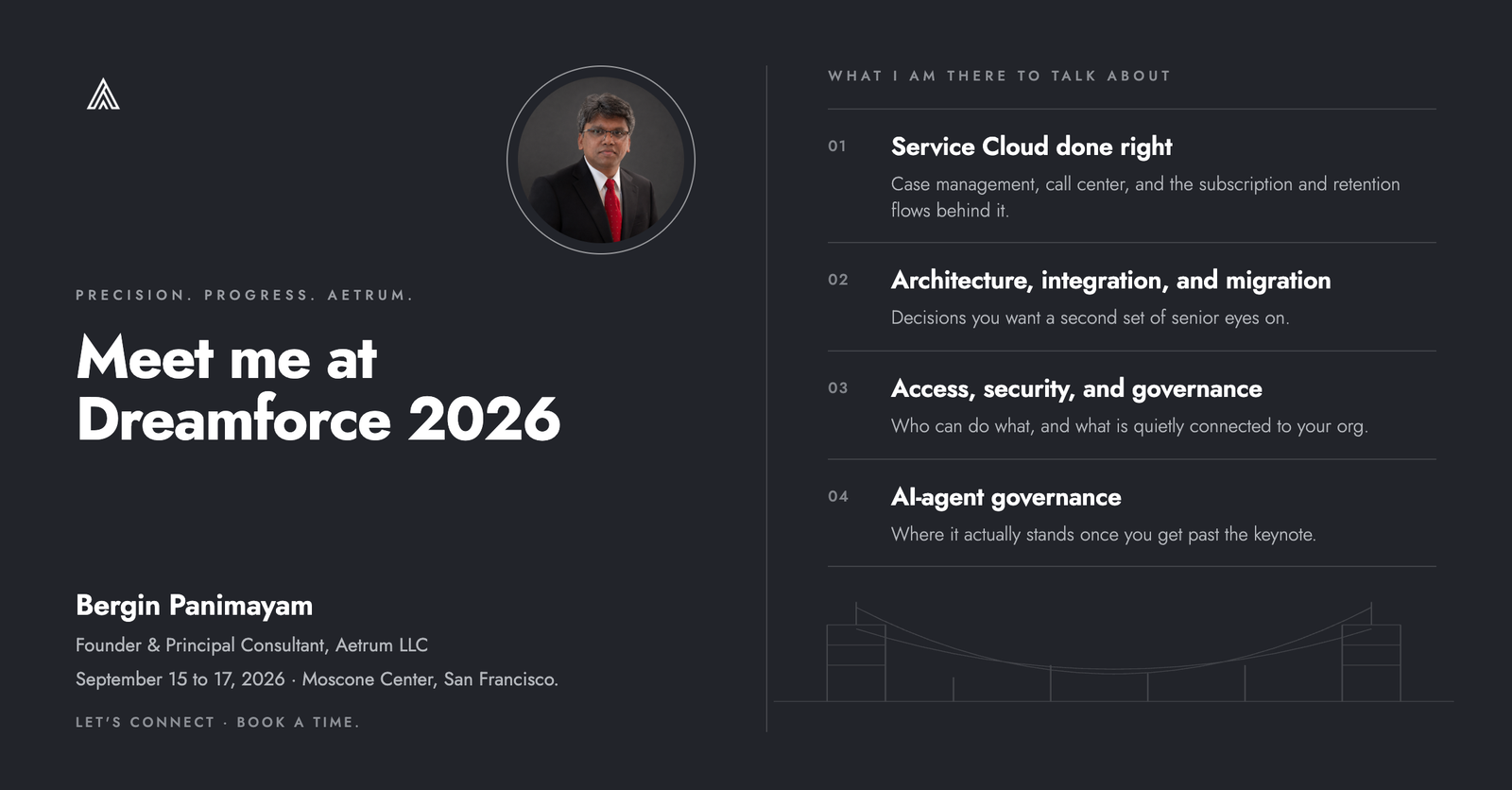
If you are attending Dreamforce 2026, I would like to meet in person. Coffee or a meal is on me, and I am happy to make it a longer sit-down if there is something real to dig into.